By Brenda Wereh03 Jul, 202532 mins read 2,519 views
0 comments 0 likes
Baltasar Ebang Engonga, former head of Equatorial Guinea’s National Financial Investigation Agency, was convicted of embezzling over 1 billion CFA francs, sentenced to 18 years in prison, and fined $1.5 million, amid a separate scandal involving leaked explicit videos.
A Malabo court delivered a landmark verdict, convicting Baltasar Ebang Engonga, the former Director General of Equatorial Guinea’s National Financial Investigation Agency, on charges of embezzlement, unlawful enrichment, and abuse of power. The 54-year-old, once a prominent figure in the country’s anti-corruption efforts, was sentenced to 18 years in the notorious Black Beach Prison and ordered to pay a fine exceeding 910 million CFA francs, equivalent to roughly $1.5 million. The ruling, which also permanently bars him from public office, marks a significant moment in Equatorial Guinea’s fight against elite corruption. Engonga’s conviction follows a tumultuous period that saw him embroiled in a separate scandal involving over 400 leaked explicit videos, which sparked global attention in late 2024. The case has ignited debates about governance, privacy, and the ethical responsibilities of public officials in the oil-rich Central African nation.
Engonga’s downfall began in September 2024, when authorities arrested him following investigations into financial mismanagement at a state-owned company under the Ministry of Finance. “He siphoned off public funds for personal gain,” said a state prosecutor during the trial, alleging that Engonga personally collected 910 million CFA francs, much of which was reportedly spent on lavish expenditures. The prosecution sought eight years for embezzlement, four years and five months for illegal enrichment, and six years for abuse of power, totaling 18 years and five months. The court’s decision to impose the full sentence reflects the government’s intent to signal a hardline stance against corruption, though critics argue the process was selective. “This trial is as much about politics as it is about justice,” said an anonymous Malabo-based activist, suggesting Engonga’s high-profile status made him a target.
The financial misconduct case was overshadowed by a sensational scandal that erupted in November 2024, when over 400 explicit videos allegedly featuring Engonga surfaced online. The recordings, discovered during a fraud probe at his home and office, reportedly showed him in intimate encounters with numerous women, including relatives and spouses of prominent government officials. The leaks, which spread rapidly across social media platforms like WhatsApp, Instagram, and X, triggered a public outcry and tarnished Equatorial Guinea’s international image. “This is a betrayal of our values,” said First Lady Constancia Mangue Obiang in a Facebook statement, describing the scandal as an embarrassment that crossed national borders. The videos, reportedly filmed with consent in various locations including Engonga’s office, fueled debates about privacy and public morality.
Engonga, a nephew of President Teodoro Obiang Nguema Mbasogo, who has ruled since 1979, was dismissed from his ANIF position via a presidential decree on November 4, 2024, citing “irregularities in his duties and inappropriate social conduct.” The decree, signed by his great-uncle, underscored the scandal’s impact on the country’s political elite. Vice President Teodoro Nguema Obiang Mangue, the president’s son, took a firm stance, ordering the suspension of officials engaging in inappropriate acts in government offices and mandating CCTV installations to prevent future misconduct. “We will not tolerate actions that undermine public trust,” Nguema said on X, emphasizing zero tolerance for ethical violations. The government also instructed regulators to curb the videos’ circulation, though their viral spread proved difficult to contain.
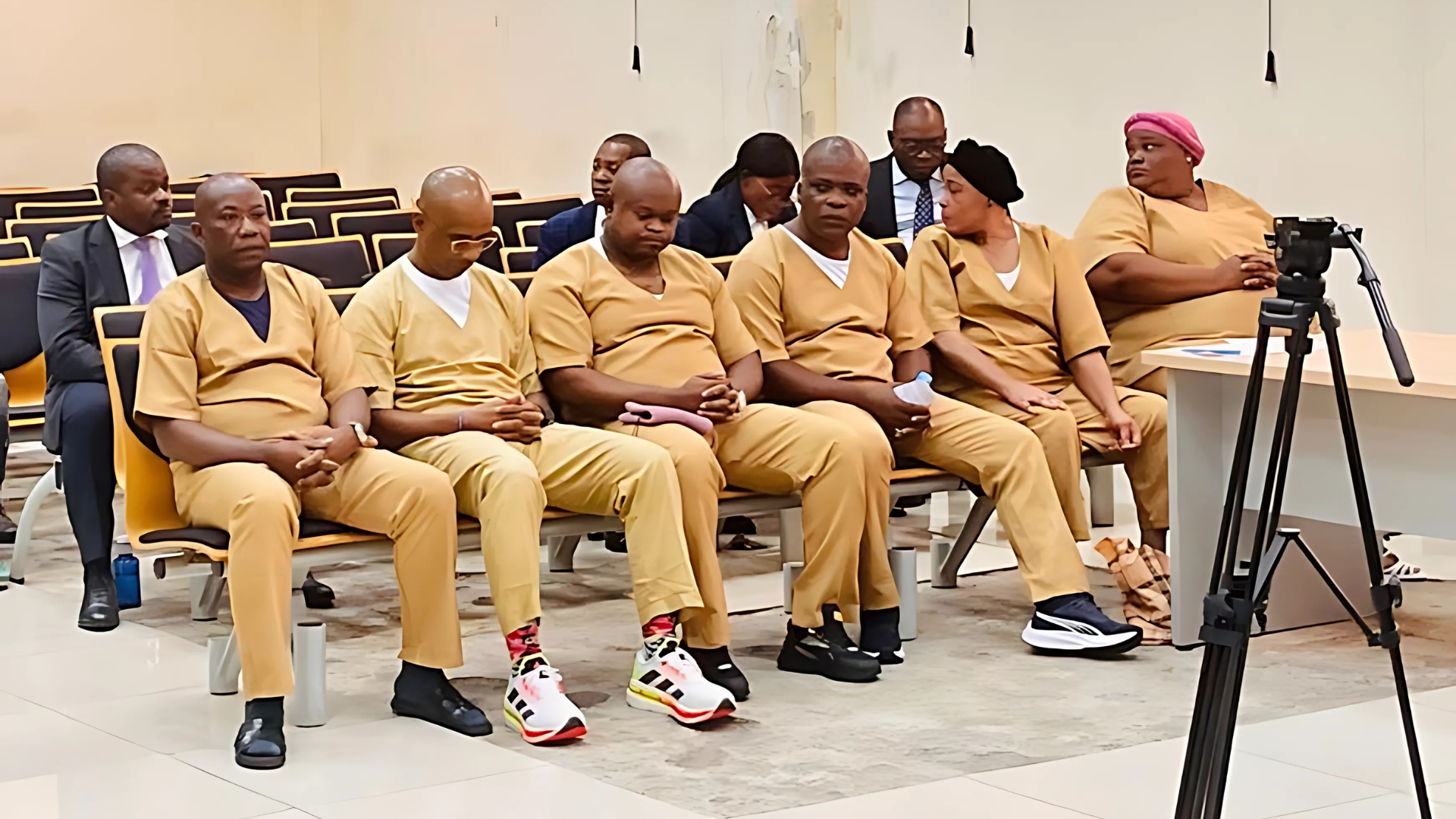
The trial, which began on June 30, 2025, involved six other former senior officials, including Carmelo Julio Matogo Ndong and Ireneo Mangue Monsuy Afana, accused of complicity in the financial misconduct. Engonga’s defense team argued that the charges were politically motivated, aimed at neutralizing him as a potential rival in the country’s succession politics. “The evidence is manipulated, and the trial is a spectacle to silence dissent,” said one of Engonga’s lawyers, rejecting the accusations as baseless. Despite these claims, the court found sufficient evidence of financial impropriety, including offshore accounts linked to Engonga, to uphold the conviction. The identities of his co-conspirators are expected to be revealed soon, with further sentencing pending.
Public reaction has been polarized, with social media platforms like X reflecting a mix of outrage, amusement, and skepticism. “Baltasar Engonga’s 18-year sentence is justice for stealing from the people,” one user posted, while another quipped, “From viral videos to prison bars, what a fall.” The hashtag #BaltasarEngonga trended alongside global events, with some users questioning the fairness of the judicial process in a country known for its authoritarian governance. “This is less about corruption and more about settling political scores,” wrote a London-based Equatoguinean activist, Nsang Christia Esimi Cruz, in a BBC interview. Others expressed sympathy for Engonga’s family, particularly his wife and six children, who faced public humiliation due to the leaked videos.
The explicit video scandal added a layer of complexity to the case, raising questions about privacy and accountability in the digital age. The Attorney General’s office initially considered prosecuting Engonga for public health violations, pending medical tests for sexually transmitted infections, but these charges were dropped after tests confirmed no health risks. One woman, Cristel Nchama, who appeared in the videos, filed a complaint with the National Gendarmerie, alleging betrayal after a four-year relationship with Engonga. “He promised me loyalty, but I was just one of many,” she said, highlighting the personal toll of the leaks. Surprisingly, some husbands of women featured in the videos expressed gratitude, noting that the leaks exposed infidelity, prompting divorce proceedings in several cases.
Engonga’s detention at Black Beach Prison, known for its harsh conditions and allegations of torture, has drawn attention to Equatorial Guinea’s human rights record. Former detainees have described physical abuse and inadequate medical care, raising concerns about Engonga’s treatment. “No one deserves that place, guilty or not,” said a human rights advocate in Malabo. The prison’s reputation has fueled speculation that Engonga’s conviction may serve as a warning to other elites. “This is about control, not justice,” said the advocate, pointing to the government’s history of targeting perceived threats to President Obiang’s regime.
The case has broader implications for Equatorial Guinea, where a small, wealthy elite contrasts sharply with widespread poverty among its 1.7 million citizens. The country’s oil-driven economy, once booming, has declined, exacerbating economic disparities. Engonga’s role at ANIF, tasked with combating money laundering and corruption, made his fall particularly ironic. “He was supposed to be the anti-corruption champion,” said a Malabo resident. “Instead, he became the face of scandal.” The conviction has sparked calls for systemic reforms, with activists arguing that selective prosecutions undermine genuine anti-corruption efforts. “If they’re serious about fighting corruption, why not investigate the entire elite?” asked Cruz.
The government’s response has been to double down on its anti-corruption narrative. Minister of Information Jerónimo Osa Osa emphasized that the investigation into Engonga’s actions would consider privacy violations and damage to the state’s reputation. “We’re protecting our country’s image and the rights of those affected,” he said. However, critics argue that the focus on Engonga distracts from larger governance issues, including allegations of secret killings and torture under Obiang’s 46-year rule. The trial’s outcome is seen by some as a test of whether Equatorial Guinea can move toward genuine accountability or remain mired in politically motivated justice.
Engonga’s conviction has also fueled speculation about succession politics, given his familial ties to the president. Some observers suggest the case is part of a power struggle, with Vice President Nguema positioning himself as a reformist ahead of a potential transition. “This is about clearing the path for the vice president,” said a political analyst in Bata. Engonga’s silence on the financial allegations, coupled with his inability to comment on the video scandal while detained, has left many questions unanswered. His legal team has hinted at appealing the verdict, but the chances of overturning the sentence in Equatorial Guinea’s tightly controlled judicial system appear slim.
As the dust settles, the case continues to resonate beyond Equatorial Guinea’s borders, with international media and social media users dissecting its implications. The viral videos, which inspired musical compositions and even a mention in a Kenyan parliamentary session, have made Engonga a global figure of controversy. “From anti-graft chief to convicted felon, his story is a cautionary tale,” said a Nairobi-based journalist. For now, Engonga remains in Black Beach Prison, his once-promising career in ruins, while Equatorial Guinea grapples with the fallout of a scandal that exposed the fragility of its political and social fabric.
Former Kiambu Governor Ferdinand Waititu has secured a major bail reprieve from the High Court, with Justice Winfrida Okwany reducing his bail from Sh53.5 million to Sh20 million cash pending appeal in his ongoing corruption case.
President Ruto and Governor Sakaja signed a cooperation agreement allocating funds for 50,000 new streetlights, water plants saving 50 million litres daily, 27 km Nairobi River sewer and ward road upgrades, with Ruto calling it a partnership to make the city livable while opposition senators warn of devolution threats.
A staff member at Moi Teaching and Referral Hospital allegedly stole Sh10 million by falsifying patient bills as paid in the eCitizen system while diverting the money to her personal account, prompting an ongoing police and hospital investigation.