State House in Nairobi was abuzz with purpose as President William Ruto and former United Nations Secretary-General Ban Ki-moon came together to celebrate Kenya’s strides in climate action and youth empowerment during a prestigious National Awards ceremony. The event, steeped in both diplomatic significance and forward-looking optimism, saw Ruto confer the Chief of the Order of the Golden Heart (CGH), Kenya’s highest national honor, on Ban Ki-moon for his global contributions to climate advocacy and sustainable development. Alongside this, the ceremony highlighted the transformative role of Kenyan youth, with several young innovators recognized for their grassroots solutions to climate challenges. The gathering underscored Kenya’s growing prominence as a leader in African climate initiatives and its commitment to nurturing the next generation of global citizens.
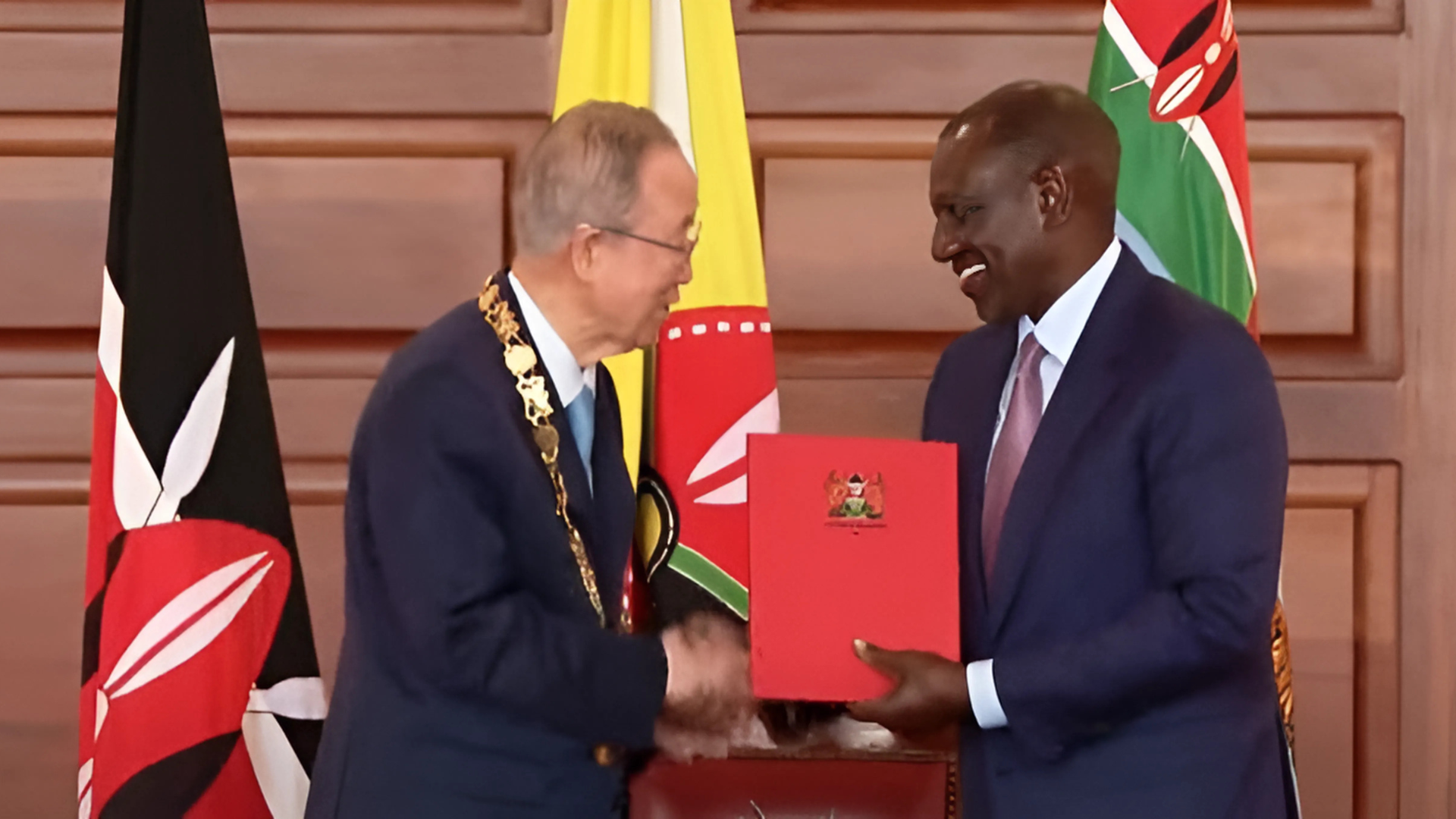
The ceremony, held under the provisions of Article 132(4)(c) of the Kenyan Constitution and the National Honours Act, was a testament to the country’s dedication to recognizing distinguished service. Ruto, addressing an audience of government officials, youth leaders, and environmentalists, praised Ban’s lifelong commitment to humanity. “Today, we honor a global leader who has tirelessly championed climate action and sustainable development,” Ruto said. “Ban Ki-moon’s work inspires us to build a Kenya that thrives in harmony with nature.” The former UN chief, visibly moved, expressed a deep personal connection to Kenya, noting that Nairobi, home to the United Nations Office at Nairobi, had been a frequent destination during his tenure. “Kenya is like a second home to me,” Ban said. “Three generations of my family have ties here, from my daughter’s wedding in Nairobi to my grandson’s early years in this vibrant city.”
Ban’s recognition was not merely ceremonial but a nod to his enduring influence on global climate policy. As UN Secretary-General from 2007 to 2016, he spearheaded the 2007 Climate Change Summit and played a pivotal role in negotiating the Paris Climate Agreement in 2015, a landmark treaty adopted by 195 countries to curb greenhouse gas emissions. His work through the Ban Ki-moon Centre for Global Citizens and the Global Center on Adaptation (GCA) continues to empower youth and women, aligning with Kenya’s own climate goals. “We have only one planet, and Africa’s role in protecting it is critical,” Ban told the audience. “Kenya’s youth are showing the world how innovation and resilience can address the climate crisis.”
The ceremony also served as a platform to spotlight Kenya’s youth, who Ruto described as the “heart of our climate agenda.” Five young Kenyans received awards for their contributions to environmental sustainability, ranging from waste management innovations to reforestation projects. Among them was Esther Wanjiru, a 24-year-old from Nakuru, whose startup converts agricultural waste into biodegradable packaging. “This award is not just for me but for every young person dreaming of a greener Kenya,” Wanjiru said, clutching her certificate. Another honoree, Samuel Otieno from Kisumu, was recognized for his community-led mangrove restoration project along Lake Victoria. “Our mangroves protect our shores and store carbon,” Otieno explained. “This work is about securing our future.”
Ruto’s focus on youth aligns with his administration’s broader ClimateWorx initiative, launched in June 2025, which aims to employ 110,000 young Kenyans in climate-related jobs like urban greening and ecosystem restoration. “Our youth are not just beneficiaries; they are leaders in this fight,” Ruto said, referencing the program’s rollout in Nairobi, where 25,000 young people are already engaged. The initiative, supported by the African Development Bank and the GCA, draws inspiration from the Africa Adaptation Acceleration Program (AAAP), co-designed to mobilize $25 billion for climate-resilient investments across Africa by 2025. Ban, as GCA chair, praised Kenya’s leadership, saying, “President Ruto’s vision for green jobs is a model for the continent.”
The event also highlighted Kenya’s role as a hub for climate diplomacy. Nairobi’s selection as the site for the GCA’s Africa headquarters, set to open in January 2026, underscores the country’s growing influence. “Kenya is leading Africa’s march toward sustainable economic transformation,” Ban said, commending Ruto’s hosting of the 2023 Africa Climate Summit, which secured $23 billion in green funding. The summit’s outcomes, including the AAAP Country Compacts, outline Kenya’s adaptation priorities, such as strengthening infrastructure and early warning systems. “Africa needs ten times the current climate adaptation funding,” Ban emphasized, echoing his 2023 call during a visit to Nairobi’s Mukuru Kwa Reuben slum, where he witnessed innovative waste management solutions by local youth.
Public sentiment on X reflected enthusiasm for the ceremony, with users praising the focus on youth and climate. “Ruto and Ban Ki-moon honoring our young innovators is a proud moment,” posted a Nairobi resident. “Kenya’s youth are the future of climate action.” However, some voiced concerns about implementation, with one user writing, “Awards are great, but we need to see these climate jobs materialize.” The hashtag #ClimateYouthAwards trended briefly, showcasing images of the ceremony and youth projects like black soldier fly farming for waste management. Critics also raised questions about Kenya’s fiscal challenges, with the country’s KSh 11.36 trillion debt prompting calls for transparency in climate funding.
The awards ceremony was not without its political undertones. Ruto’s emphasis on youth and climate comes amid efforts to consolidate support in the Mount Kenya region, where political tensions with former Deputy President Rigathi Gachagua have intensified. By aligning with global figures like Ban and showcasing tangible initiatives, Ruto aims to bolster his image as a forward-thinking leader ahead of the 2027 election. “We are building a Kenya that works for all, not just a few,” Ruto said, subtly addressing critics who accuse his administration of uneven development focus. Ban, steering clear of local politics, praised Kenya’s democratic resilience, saying, “Your commitment to inclusive governance inspires the world.”
The youth honored at the ceremony represent a cross-section of Kenya’s innovation landscape. Mary Njoroge, a 27-year-old from Mombasa, was recognized for her solar-powered water purification system, which serves over 500 households in coastal villages. “Clean water is a climate issue,” Njoroge said. “My system reduces reliance on fossil fuels and helps communities adapt.” Another awardee, David Mwangi from Nyeri, developed a mobile app connecting farmers to climate-smart agricultural practices. “Farmers need real-time data to survive droughts,” Mwangi noted. “This app is saving livelihoods.” These projects align with the Ban Ki-moon Centre’s “Your Future in Green Jobs” course, which equips youth with skills for sustainable careers.
The ceremony also highlighted Kenya’s broader climate strategy, including the National Climate Change Action Plan, overseen by the National Climate Change Council chaired by Ruto. Kirinyaga Governor Anne Waiguru, a council member, attended the event and reiterated the need for county-level climate funds. “Counties have allocated KSh 877 million for adaptation, but we need more international support,” Waiguru said, echoing Ban’s call for increased global financing. The council’s efforts to update the action plan focus on low-carbon development, a priority as Kenya aims to expand its power grid to 100 gigawatts by 2040, with 80 percent from renewable sources.
For Ban, the event was a personal milestone, given his family’s ties to Kenya. He shared a light-hearted anecdote about attending his daughter’s wedding in Nairobi as South Korea’s foreign minister, taking a secret leave to celebrate. “Kenya has given me not just professional purpose but personal joy,” he said, drawing applause. His work with the GCA and the Ban Ki-moon Centre continues to focus on youth, with programs like the Global Citizen Scholarship empowering young Africans to lead SDG-related projects. “The youth of Kenya are global citizens,” Ban said. “Their creativity and courage will shape a sustainable future.”
As the ceremony concluded, Ruto called for global cooperation, advocating for a carbon pricing system to reflect the true cost of climate change. “Africa contributes the least to emissions but suffers the most,” he said. “We need fair financing to protect our people.” The event, blending high-level diplomacy with grassroots recognition, positioned Kenya as a beacon of hope in the global climate fight. For awardees like Wanjiru, the moment was transformative. “This recognition fuels my drive to keep innovating,” she said. As Kenya navigates economic and political challenges, the spotlight on climate and youth at State House signals a commitment to a greener, more inclusive future.